

The things you think about
By lex, on March 29th, 2007
Our conversation below *** on the Code of Conduct and Leading Sailor Turney brought some thoughts back to mind that I hadn’t turned over in quite a number of years.
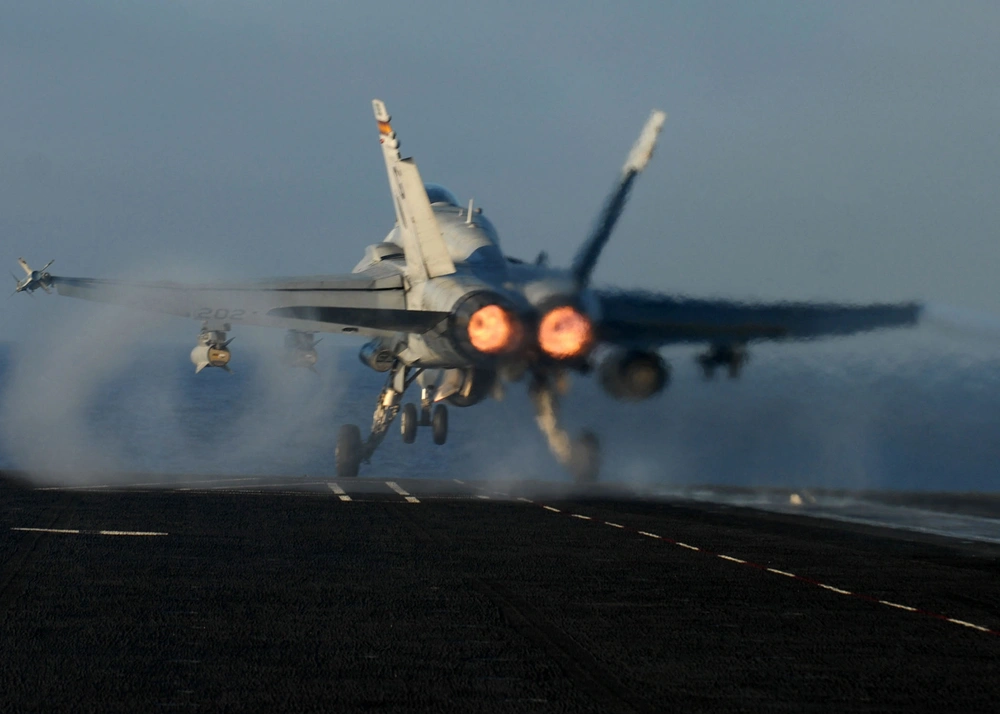
I had three deployments flying over Iraq enforcing sanctions in the southern no-fly zone between the wars. Each time we went the political situation was a little different. During my first trip up there 1994, we mostly flew two-ship defensive counter-air missions, designed to protect Kuwaiti and the southern Iraqi Shia provinces from air attack by a vengeful Saddamite air force. It was pretty peaceful for the most part, and in fact we used to recce SAM sites by doing target acquisition missions in the threat envelope, vying to see who could bring back the best FLIR video. Crazy when I think about it now, but we’d won the war, hadn’t we?
We didn’t know any better.
By the time of my last flying deployment in 1998-99, the focus had changed and each of our “box” hops was like a mini-strike, complete with tanking plans, SEAD and USAF coordination. Tensions escalated in December of ’98 – we got to the Gulf just after Saddam had gone through one of his UN inspector-ejecting spasms, and in time to join a previously stationed east coast carrier that had been launching air strikes the previous four days in support of President Clinton’s Operation DESERT FOX. We launched one strike of our own – I wasn’t on that strike, I was setting up to lead our ship’s second strike in country – when the word came down that we’d accomplished whatever it was we were supposed to have been accomplishing and that it was time to stand down.
When we had first gotten there, the airspace had been fairly unrestricted – there was one long-range SAM site in Najaf, and another, shorter range one in Basra I believe, but after that it was clear sailing almost all the way up to Bagdhad, or at least as far as the 32nd parallel. But during our 30-day, self-imposed stand-down – ostensibly to show our sensitivity by observing Ramadan – Saddam threw every surface-to-air missile system he could scrape together into our airspace.
What had been relatively permissive environment was now a damned tight bit of maneuver space, into which a lot of high speed aluminum was routinely packed, most of it going in different and non-complimentary directions.
And as if all those machines weren’t a sufficient threat to each other, when Ramadan ended and we started flying in the Box again, Saddam started shooting at us – anti-aircraft artillery, mostly, since we were smart enough to stay out of the missile engagement zones and the SAM operators were (mostly) smart enough not to shine their radars at us when we were out of range. Churchill said that there is nothing quite so exhilarating as being shot at and missed, which is true at first, but after a while it can also get nettlesome.
The odds of getting hit by undirected AAA at the altitudes we operated at were pretty small – and undirected AAA was the main threat, as anyone shining a fire control radar on an arty tube was begging for a self-defense anti-radiation missile to be shoved down his throat – but while small, the odds were non-zero. On top of the ever present risk of clacking into one another, we used to also fret about getting hit by a “golden BB.” After all, you put enough trash in the air, and eventually someone’s going to run into it, which, if it hits you someplace vital then you’ll have to ditch the jet and go for a walk.
In very likely the same neighborhood where someone was just shooting at you. Which sucks.
Speaking of suck, there are few experiences to match, for sheer density of compacted suckage, SERE school. “Survival, evasion, resistance and escape.” Even though our instructors were Americans, and military servicemen who at their heart wanted to make sure that we all got through it OK, it was still pretty much the Worst Thing Ever. The lesson I most of all took away from that was, “Don’t get captured. Ever.”
People carried different things on their trips into “the Box.” On top of all the usual survival gear, I carried a lot of extra water, a blood chit, morphine ampules (it may be true as the Marines say that “pain is weakness leaving the body,” but it’s also true that it’s easier to run south on broken ankles if you’ve got morphine in your system), a 9mm pistol (although I would have much preferred a .45, they weren’t issuing them) and two mags of ammo, 16 rounds in all.
I was suiting up one day and noticed that one of my wingmen – a junior guy whom I respected, and a real knife-in-the-teeth warrior in an airplane – wasn’t carrying a pistol. I asked him why. Turned out that one of the guys he’d known who got bagged by a SAM during the ’91 scrape was quickly surrounded by Republican Guards before he’d even had a chance clear his parachute, much less clear leather. The agitated Iraqis – and I reckon you’d be agitated too, if someone had been bombing the hell out of you pretty much non-stop for five weeks – yanked his pistol out of its holster and shoved it in his mouth, which if you’ve ever hefted and smelt a pistol is a pretty vivid image even before you paint the angry Iraqi soldier into the background. That was enough for my man.
Which was right for him, I guess – you couldn’t make a guy carry a personal sidearm, or anyway, having ordered him to carry it, you could scarcely order him to use it in his own self-defense unless you wanted to jump out of the jet beside him when he went down. Which, they may have done that sort of thing back during the Korean War, but it’s fallen out of favor in recent years.
I felt differently of course. I told him that one of my first mentors told me that if you get shot down the war hadn’t ended, it’s just the tactics that have changed. And while that may sound like fighter pilot braggadocio, it was also true that if there was one Iraqi farmer there with a pitchfork standing between me and liberty, it’d be nice to have Mr. Glock around to demonstrate his poverty of options, came down to it.
What I didn’t say but was privately thinking was that 16 rounds gave you 15 chances to escape and one alternative to surrender.
It’s funny what you think about.
*** 07-28-2007 Link added – Ed.
Back To The Secondary Index